The shopping context is shifting faster than most merchants notice day-to-day. Today customers still type "Which hiking boots keep water out at freezing temperatures?" into a search engine and click. Tomorrow they ask Claude, ChatGPT or an assistant embedded directly in the storefront — and it decides which shop delivers the answer. This is not the next search evolution. This is Agentic Commerce.
What is Agentic Commerce?
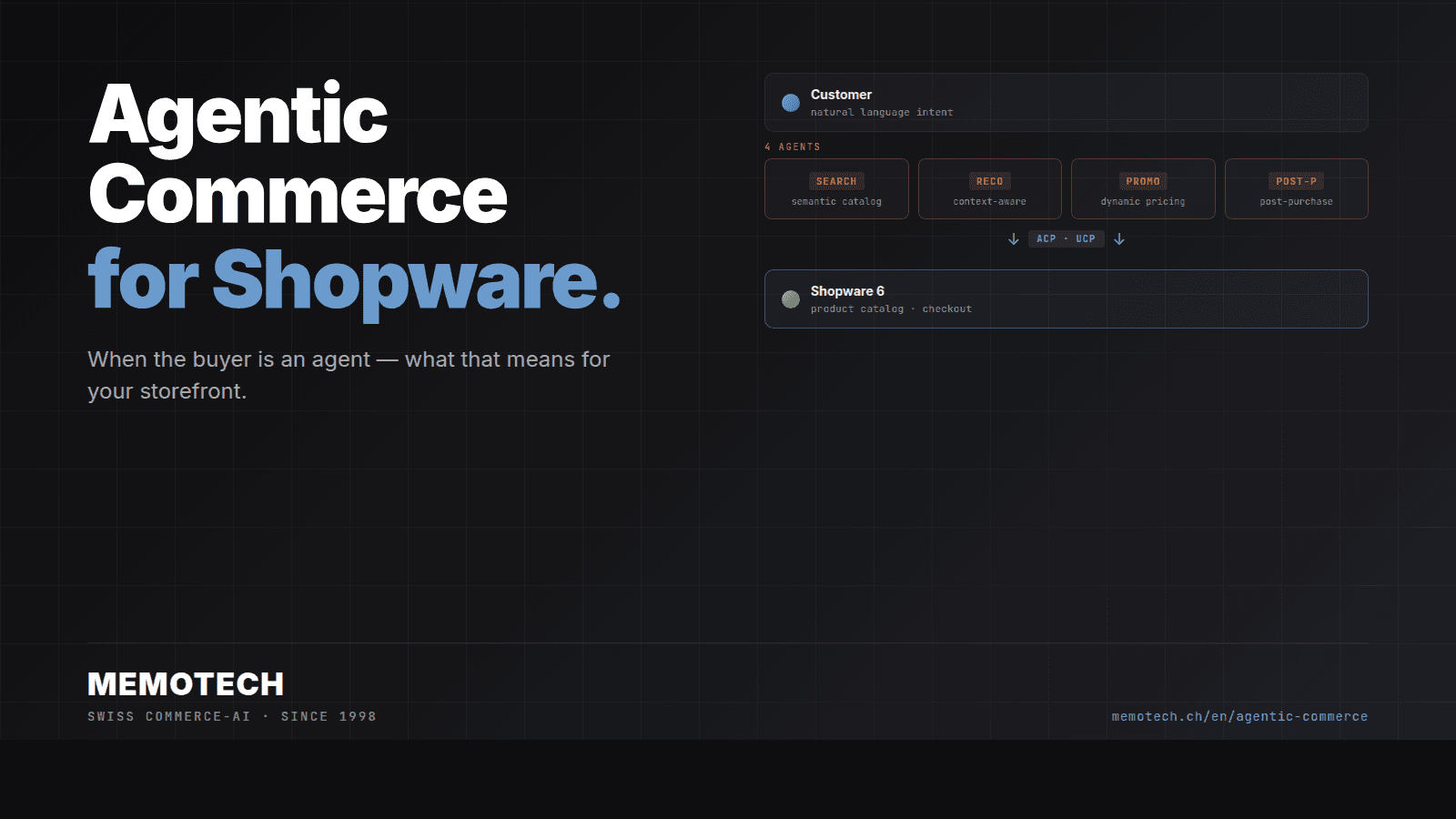
Agentic Commerce describes shopping interactions where an AI agent — an LLM with tool access — sits between the customer and the shop. The agent understands natural-language queries, searches product catalogs semantically (vector embeddings instead of keyword match), aggregates offers across shops and, if needed, executes the checkout itself. Behind it stand open protocols such as the Agentic Commerce Protocol (ACP) — driven by OpenAI and Stripe — and the Universal Commerce Protocol (UCP), launched by Google with Shopify, which covers the path from search to order. Since March 2026 Shopify has connected shops to ChatGPT, Gemini, Copilot and Meta through Agentic Storefronts; in ChatGPT, the purchase completes in the shop's own checkout. In June 2026 Shopware announced full MCP coverage and UCP readiness.
Why does this hit e-commerce merchants now?
Short version: because visibility is tipping. Three shifts are accelerating it:
- AI traffic is growing fast. Adobe counted almost five times as many visits from AI assistants to US retail sites in Q1 2026 as a year earlier, and still more than twice as many in May 2026. Consumers are increasingly delegating product research to agents.
- Shopping widgets are becoming default UX. Embedded on the product page, in the header, in chat — AI answers service questions and sells within the same dialogue.
- Conversion data is shifting. Semantic search and contextual recommendation are replacing facet navigation. Merchants without structured product data lose to merchants with it.
For online shops this means: the product catalog has to be machine-readable (clean taxonomy, structured metadata), the service FAQ has to be indexable, and a customer-facing AI layer belongs in the storefront — not in a separate support channel decoupled from conversion.
Where MEMOTECH stands
MEMOTECH has been building its own Agentic Commerce platform as a reference implementation since Q1 2026 — Swiss-based, Apache 2.0 platform foundation. Shopware 6 connects natively, any other shop software through its product feed; both read the catalog. We build cart and checkout inside your own shop on request; demos are available too, with your own product feed if you like. Technical details and measurements are published openly on the MEMOTECH Blog (English-language deep dives). If you want to understand the shift before it reaches your own conversion, the material lives there.